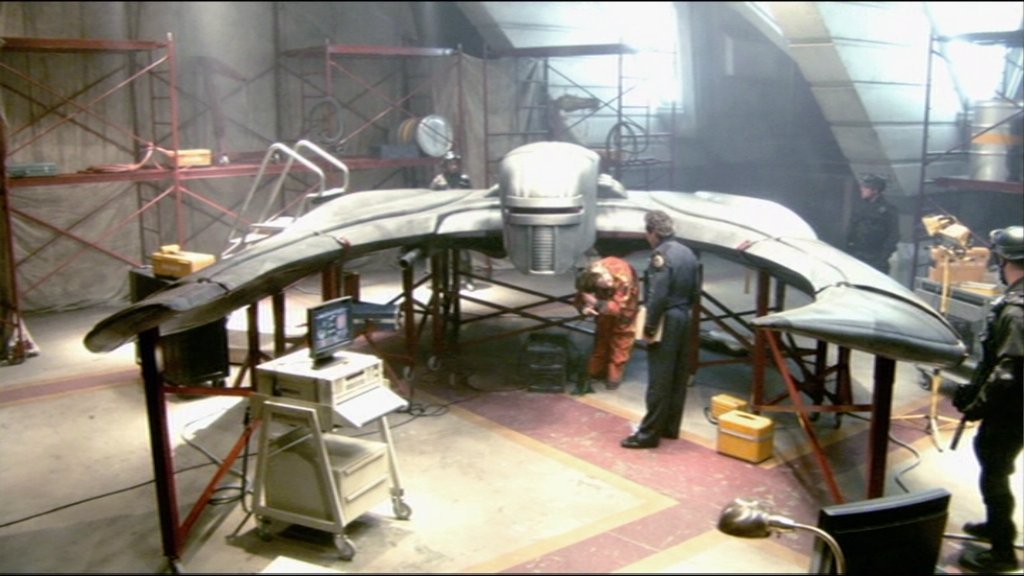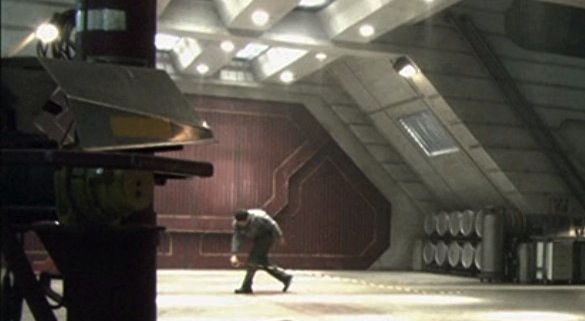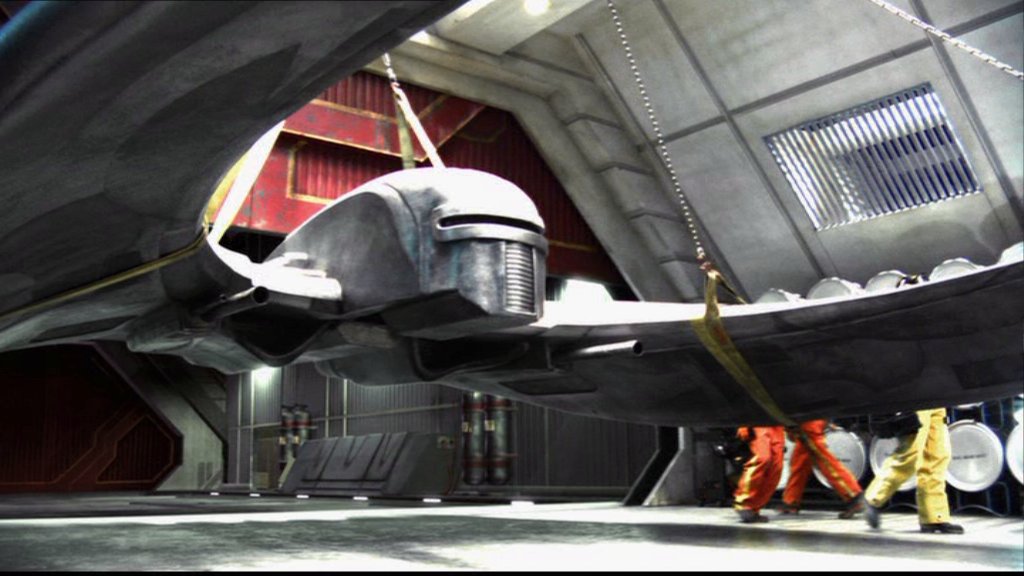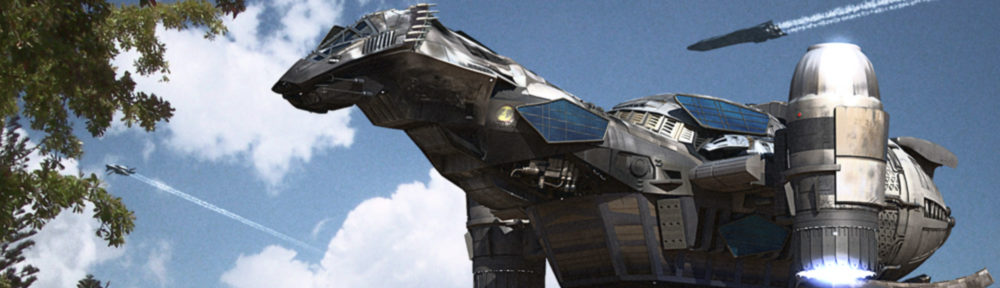
The most popular post on this blog has far and away been my reconstruction of the Battlestar Galactica hangar deck. I mentioned I intended to write further analyses later on. This post will discuss the war-era version of Galactica, seen in the prequel movie Blood and Chome.
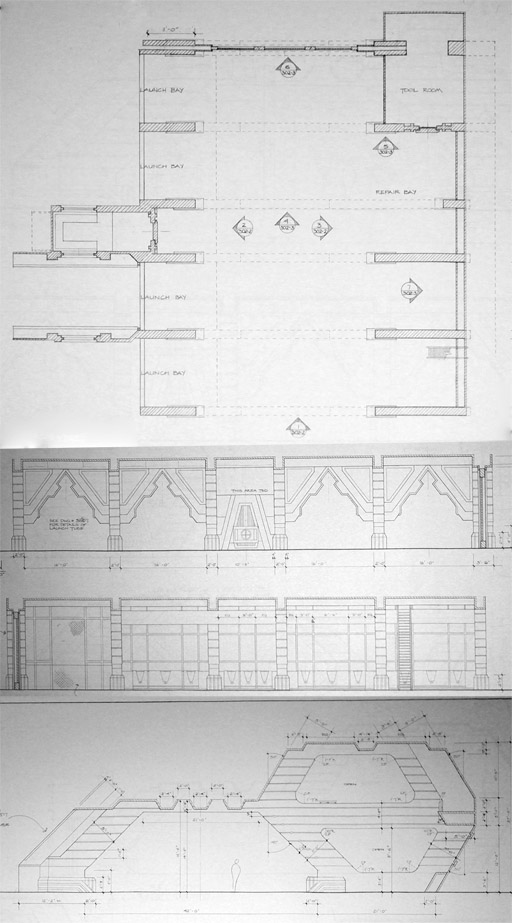
The B&C hangar deck was designed more loosely than the original version, and things don’t fit together as easily as they did in the first article. I’m going to try and come up with a compromise interior and exterior that works together, but still looks similar enough to what was actually on-screen that the casual observer might not notice if a hypothetical Blood and Chrome II (or some sort of fan-art) used my design. I’ll be using the original set blueprints as a base, and hacking them into something resembling the B&C design. These are mostly intended to be layout guides if and when I model the hangar myself later on, so they’re going to be pretty rough, and missing some features.
Exterior:
The exterior of the flight pods (including the flight deck) was not altered for B&C (except for the additional armor plating and weapons), so everything I said about launch tubes and aircraft elevators in the first post still applies. To recap;
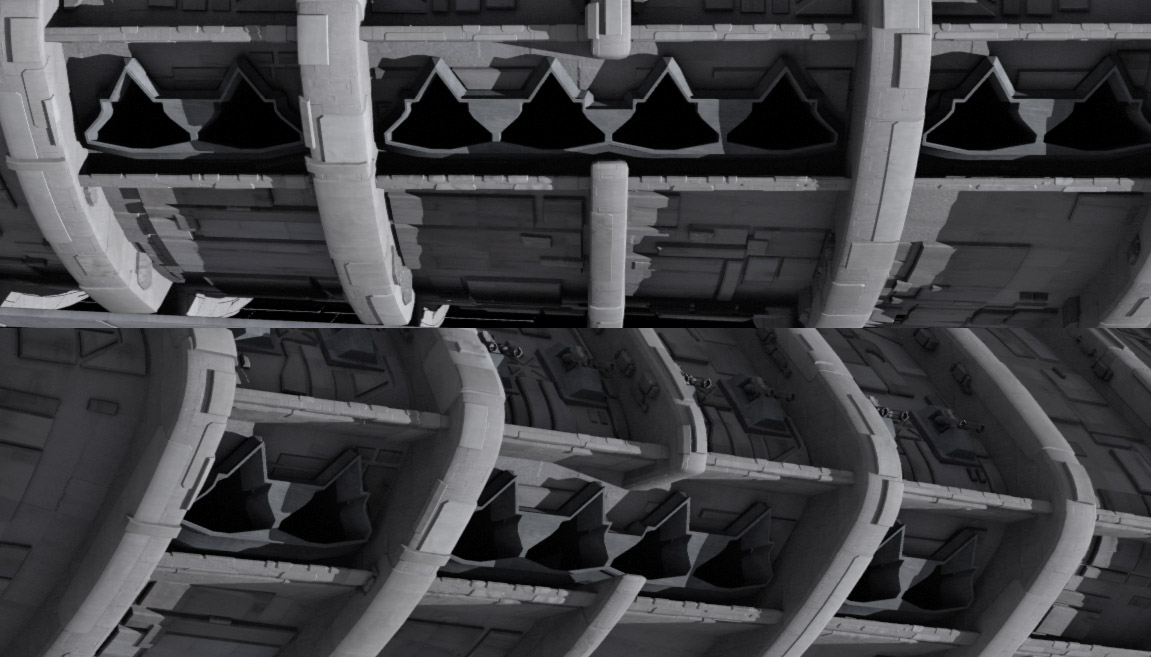
On the Galactica, there are five clusters of eight launch tubes each. Each cluster takes up four “frames” of the hull. The launch tubes in the cluster are arranged with two tubes, then a rib, then four tubes (with a cutout where the rib should be), another rib, and two more tubes. Each cluster is separated by a single empty frame.
It’ll be important later, so I’ll note that while I’m confident the actual model of the landing deck is identical to the original with the jetways for larger ships and the six aircraft elevators, we only actually see a small portion of the rear, so we only know that there’s one aircraft elevator of this type. There could be anything behind the camera’s point-of-view.
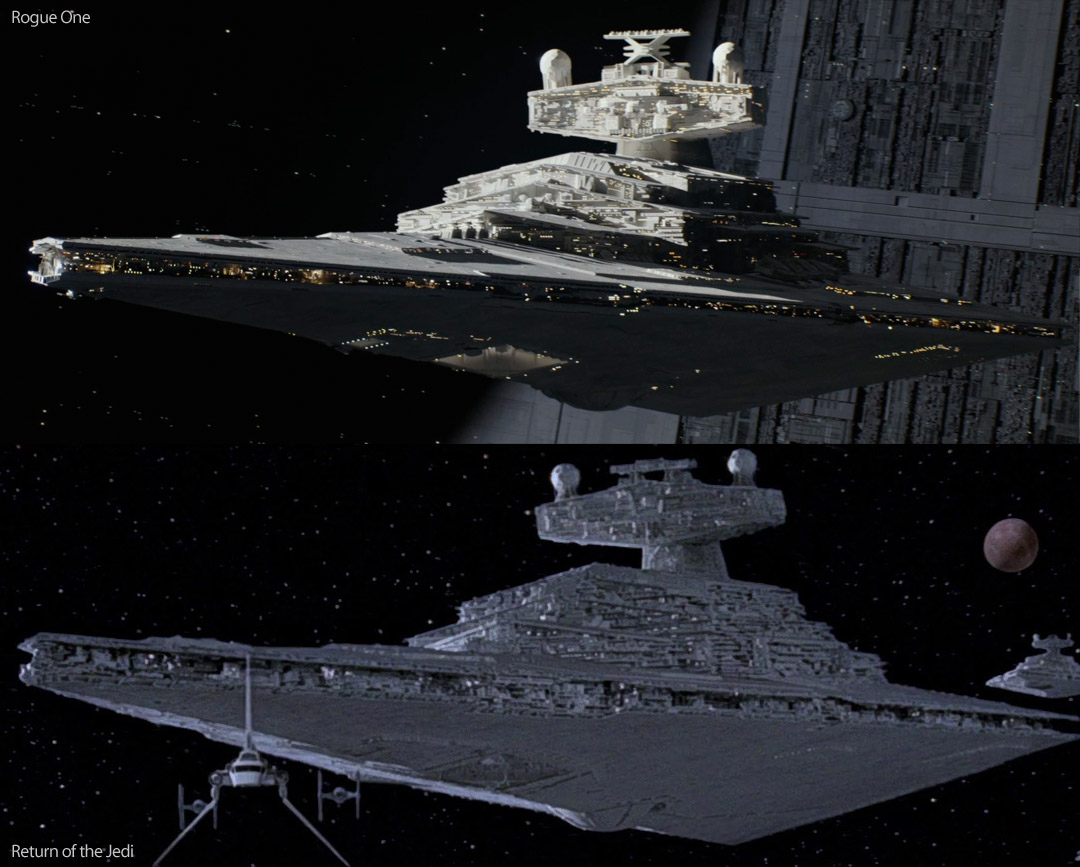
Not that it matters in this post, but let’s just note that there were two versions of the Galactica made for B&C, with different arrangements for the additional weapons. One appeared in the opening montage and in the closing scenes of the movie, and the other was seen in the scenes were Adama arrives, then departs, in the beginning. Since it was shown more prominently, I regard the version from the arrival scene as correct, and the other one as the error. By the way, if anyone knows how this happened, or if it was intentional and there’s some deeper meaning in the canon to the Galactica having her guns rearranged while Adama was off playing ice-commando, drop me a line with the contact button on the upper right.


Interior:
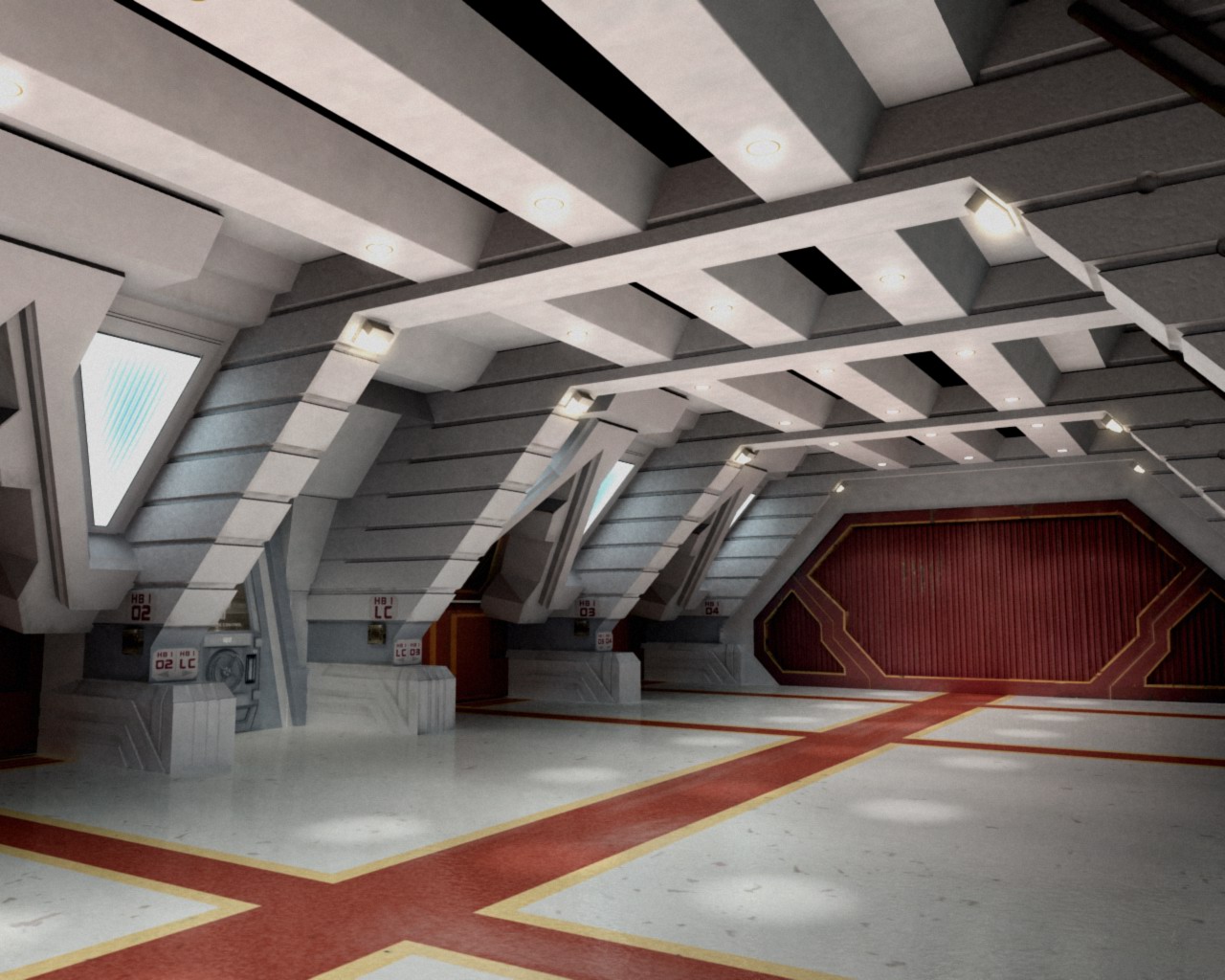
The 3D model for the hangar deck is made up of modules, each three Viper racks wide. Doug Drexler posted a diagram on Facebook with a note describing multiple types of module:
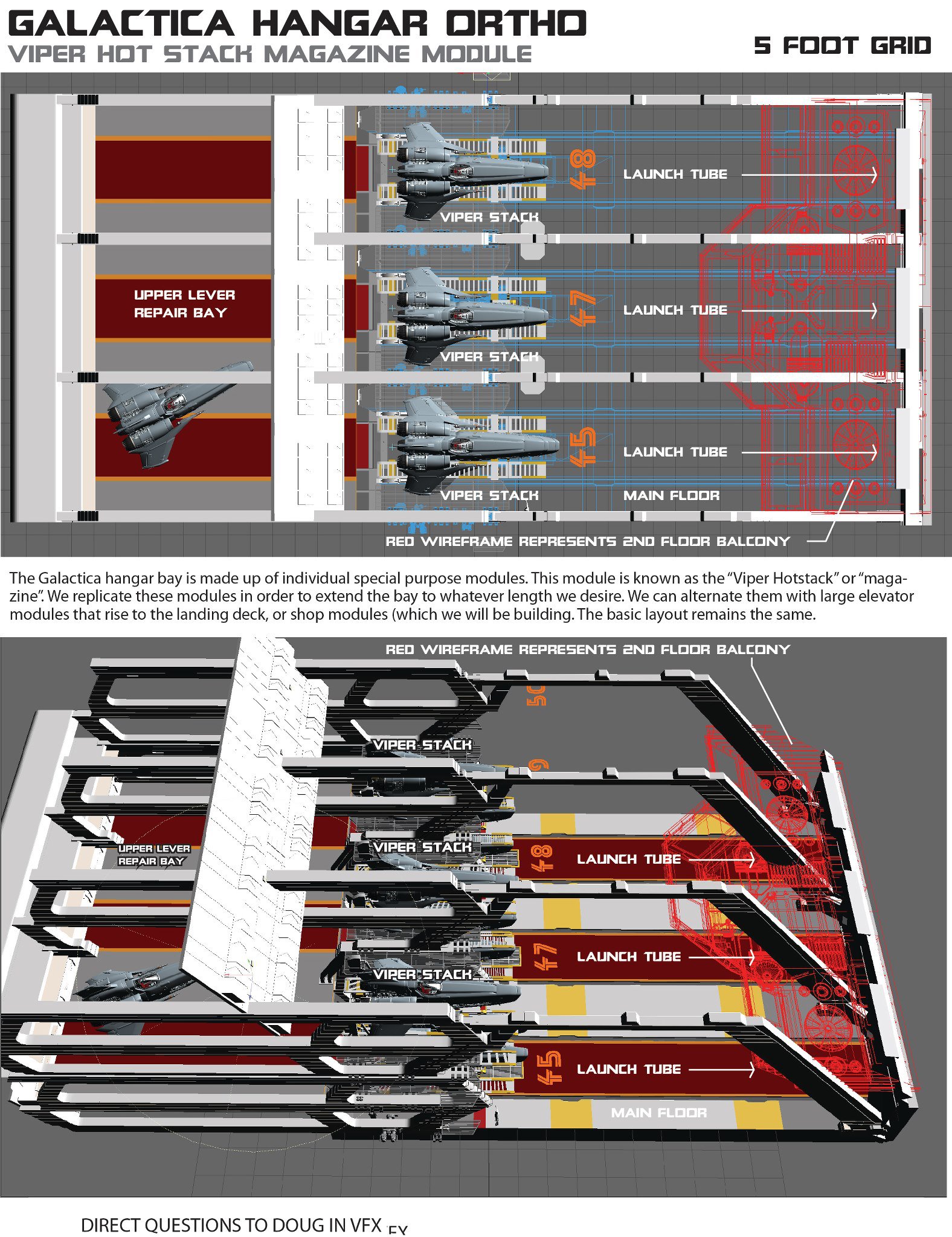
We can alternate [the “Viper Hotstack”] with large elevator modules that rise to the landing deck, or shop modules…. The basic layout remains the same.
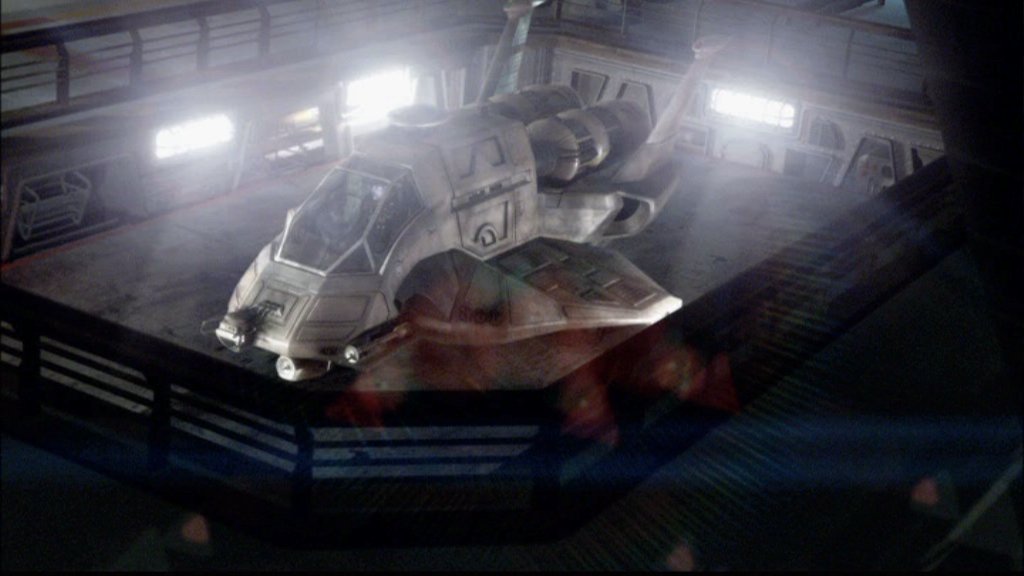
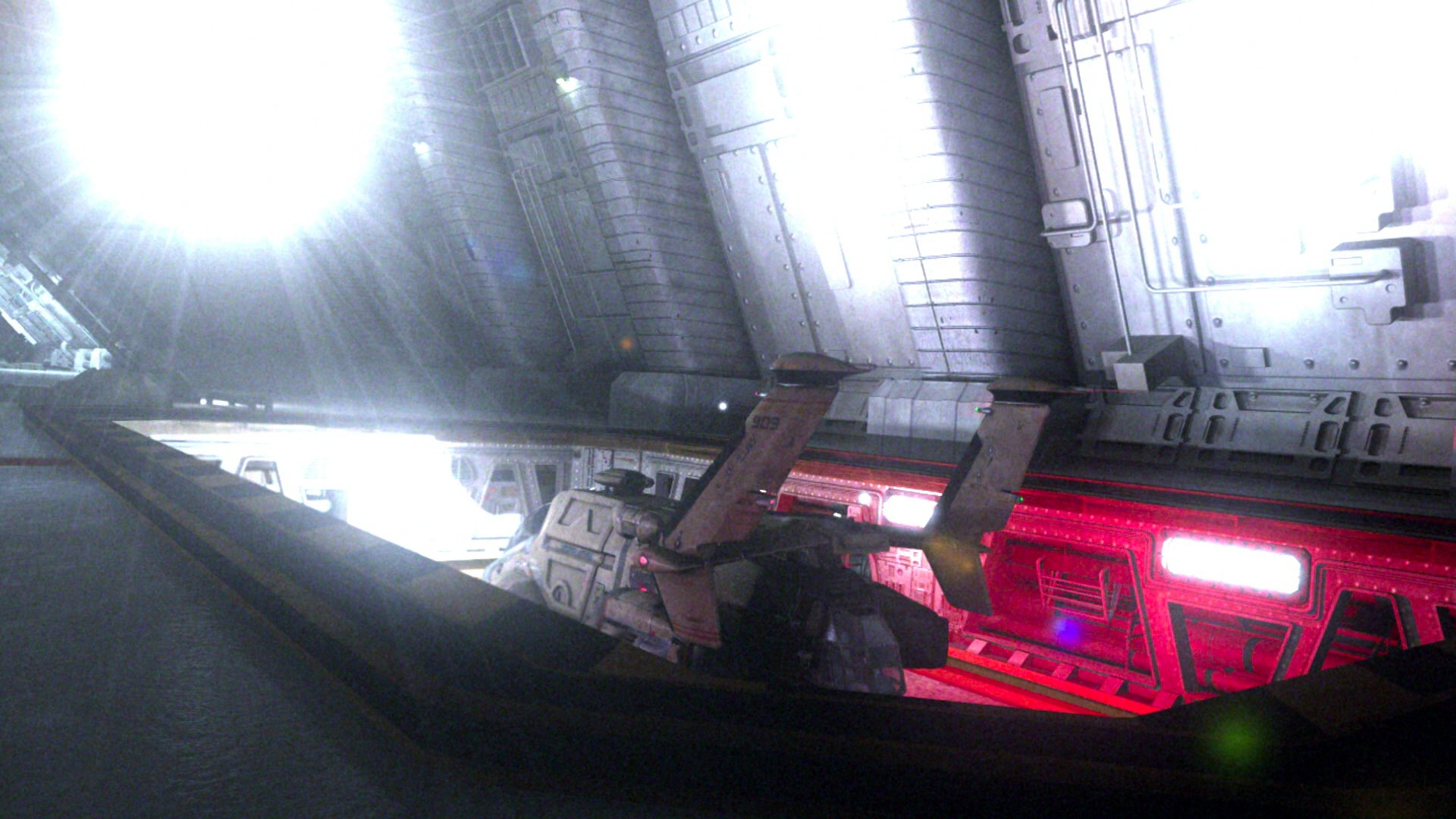
(The berth the Wild Weasel was parked in with the large bulkhead door was the “shop” module.)
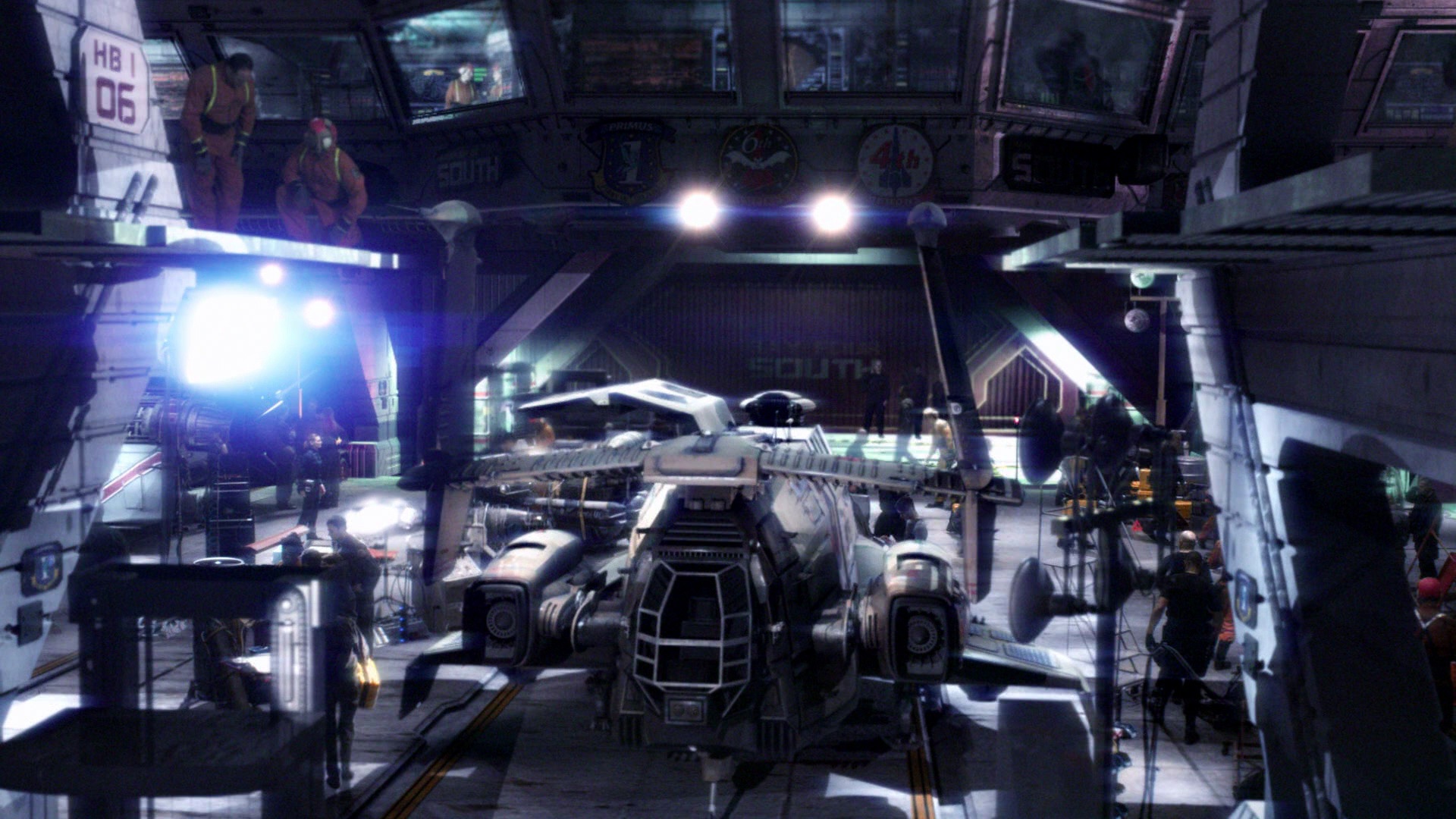
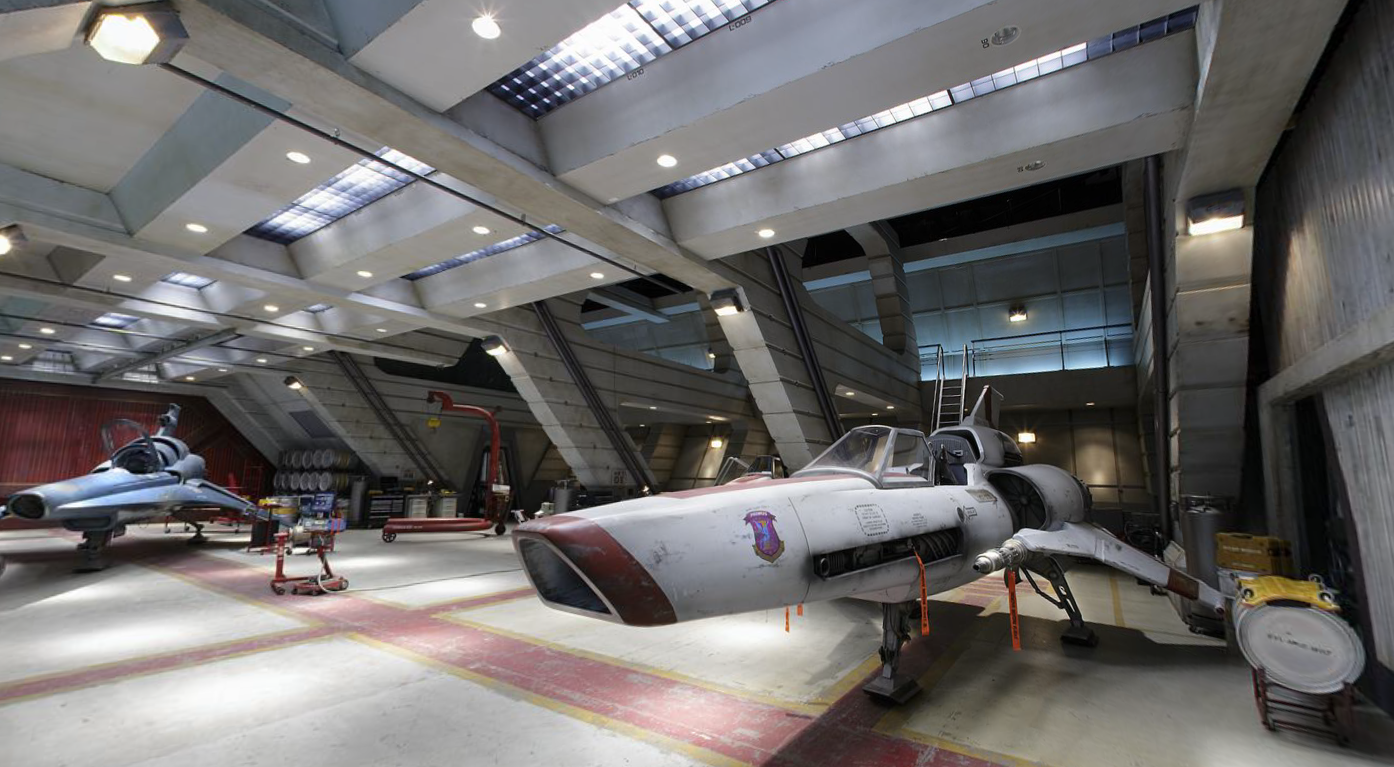
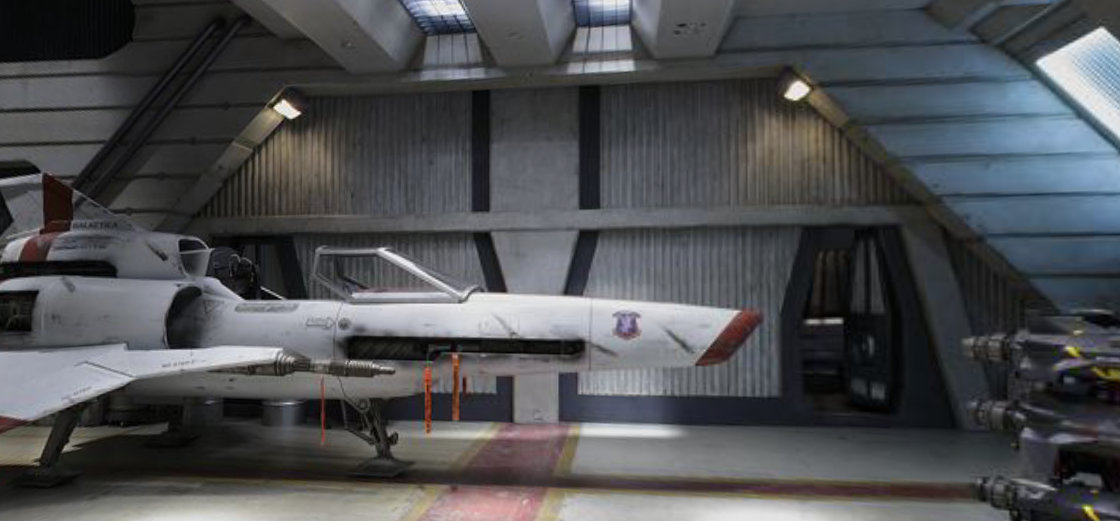
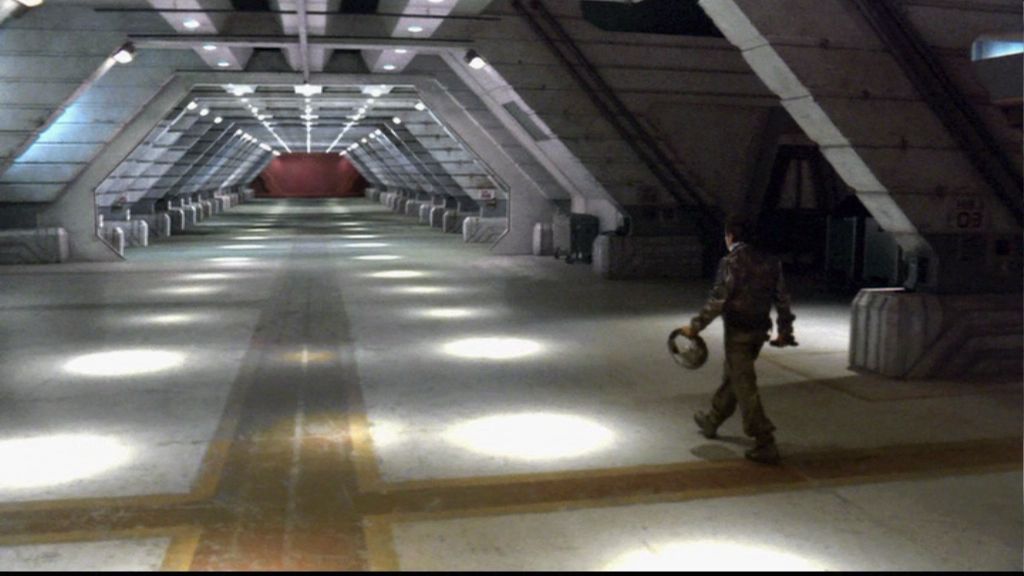
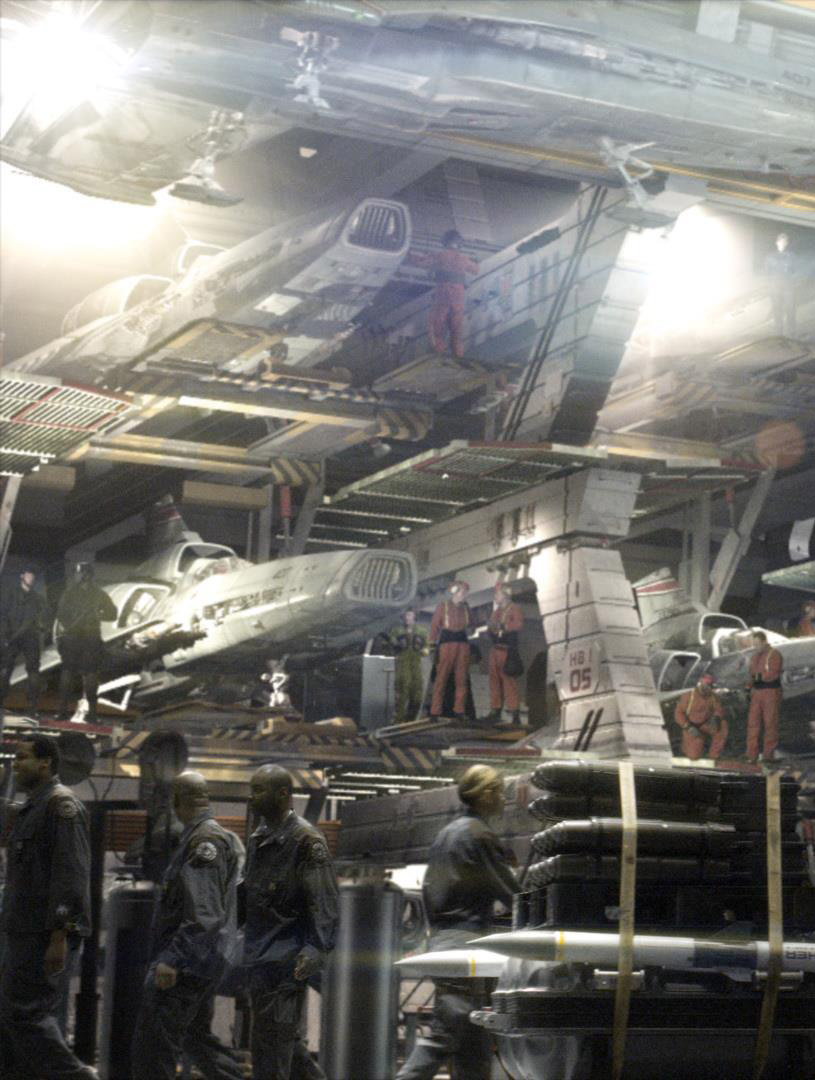
The most prevalent module was the “Hotstack.” The hangar is four levels high, with three levels in the stack open to the air, and the topmost peaking out from behind the ceiling. Vipers lower from an apparent, barely-visible fifth level.
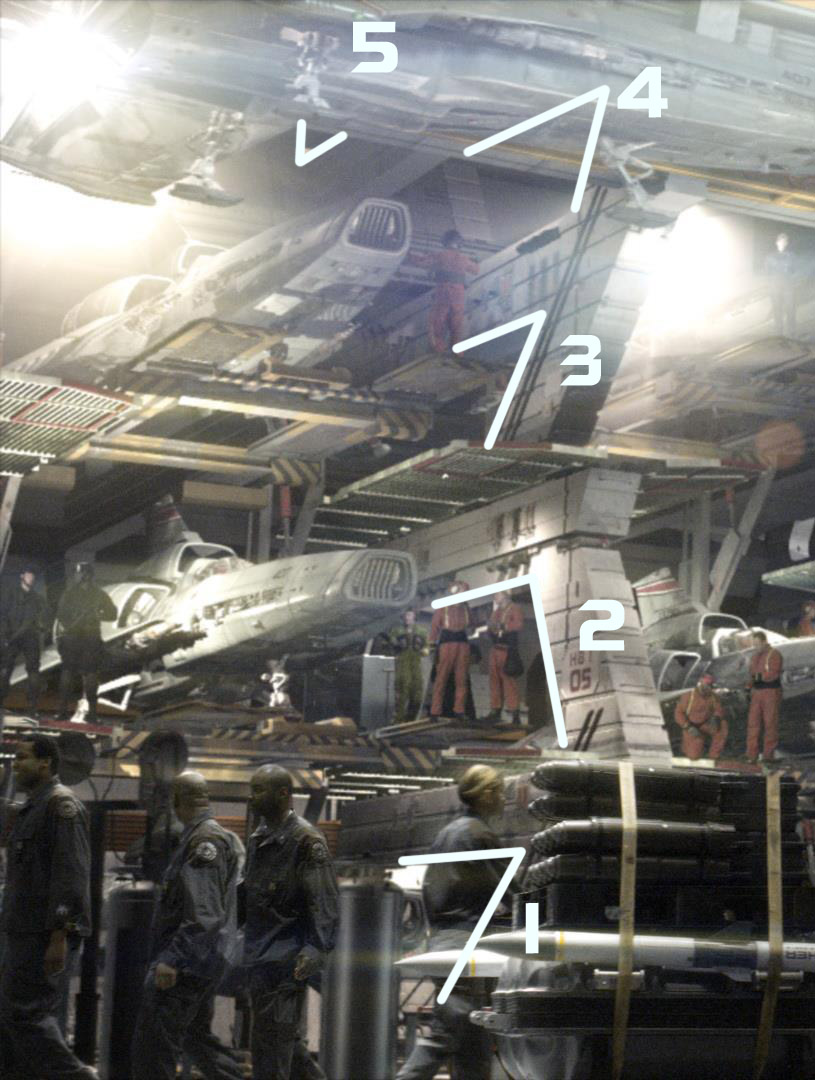
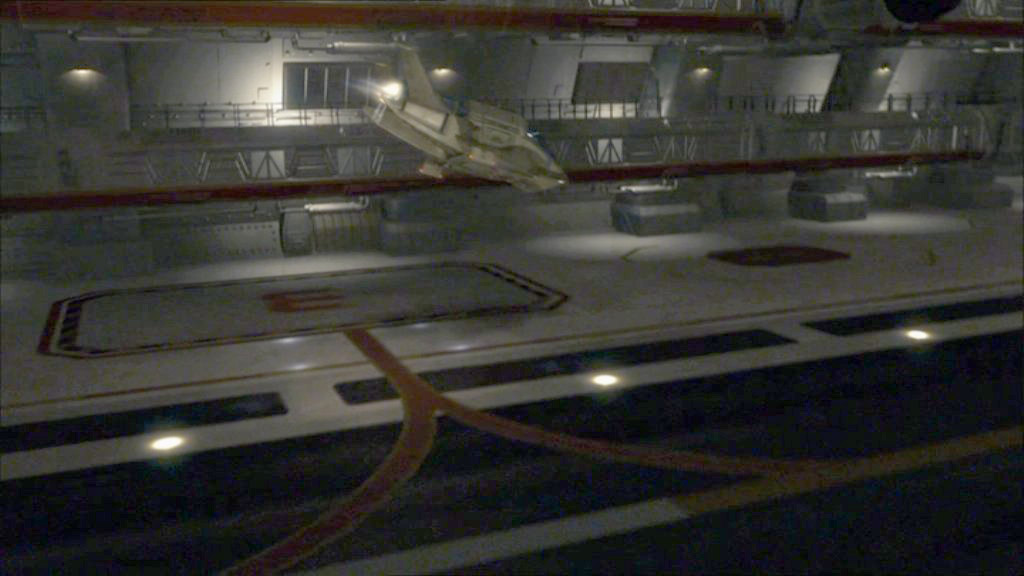
The outboard side has an enclosed control room running the length of the pod at the same height as the second level, and has triangular sections at deck level that that seem to lead to the launch tubes, though we never see one clearly. The roof of the control balcony has railings and people standing on it, though how they got there and what business they have up there is anyone’s guess. Given the rough texturing, it obviously wasn’t a section of the set expected to get much attention. After all, it’s only clearly visible in one-and-a-half shots for a second or so. The center roof has a system of carts and gantries running along rails, apparently moving Vipers from one upper level stack to another. There also seems to be some kind of fixed Viper bridge from inboard to outboard about one and a half levels up, just before the elevators. It seems to be the match of the structure the Viper in the foreground is sitting on. The entire configuration is about 21 Viper-stacks long.
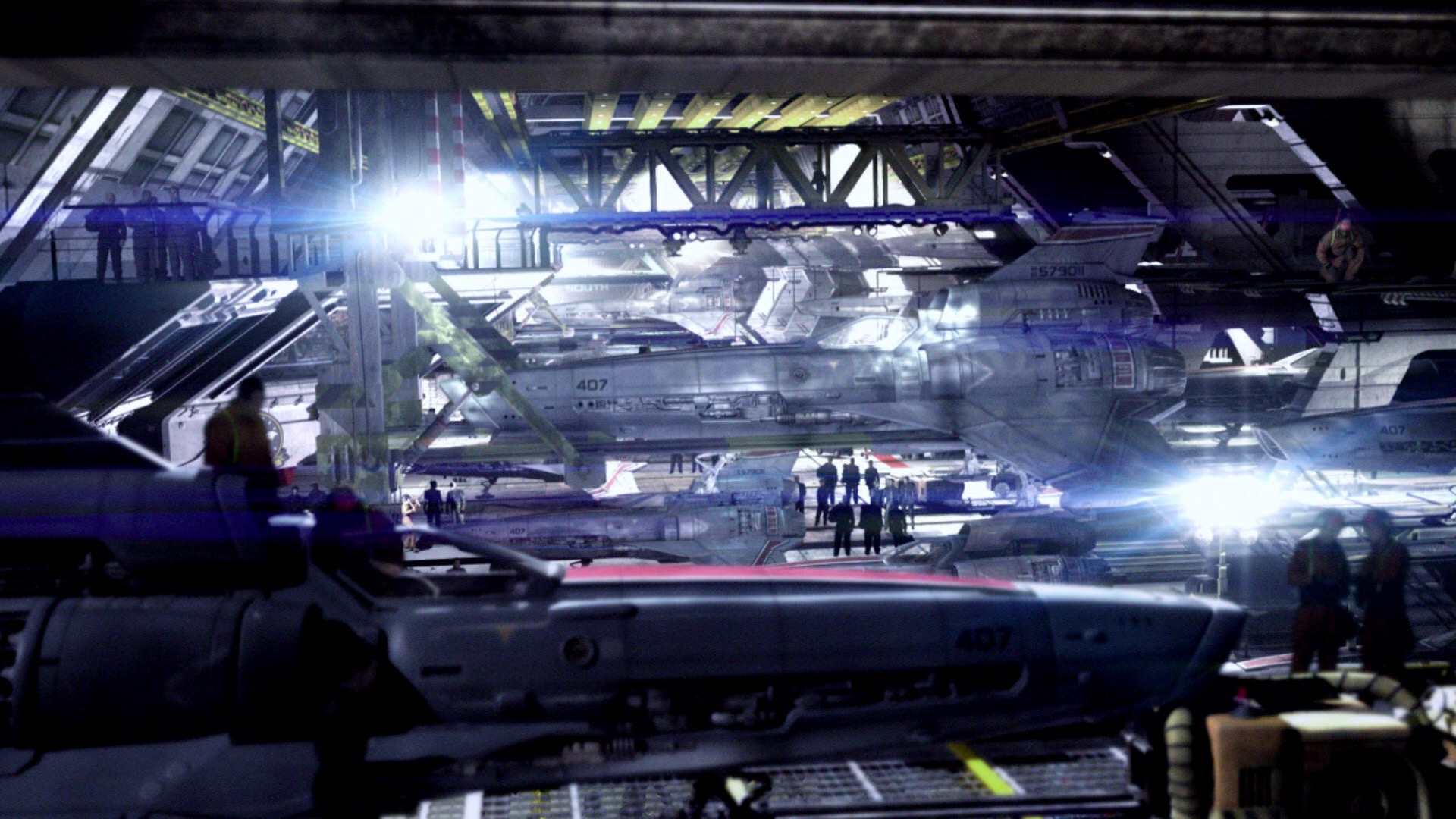
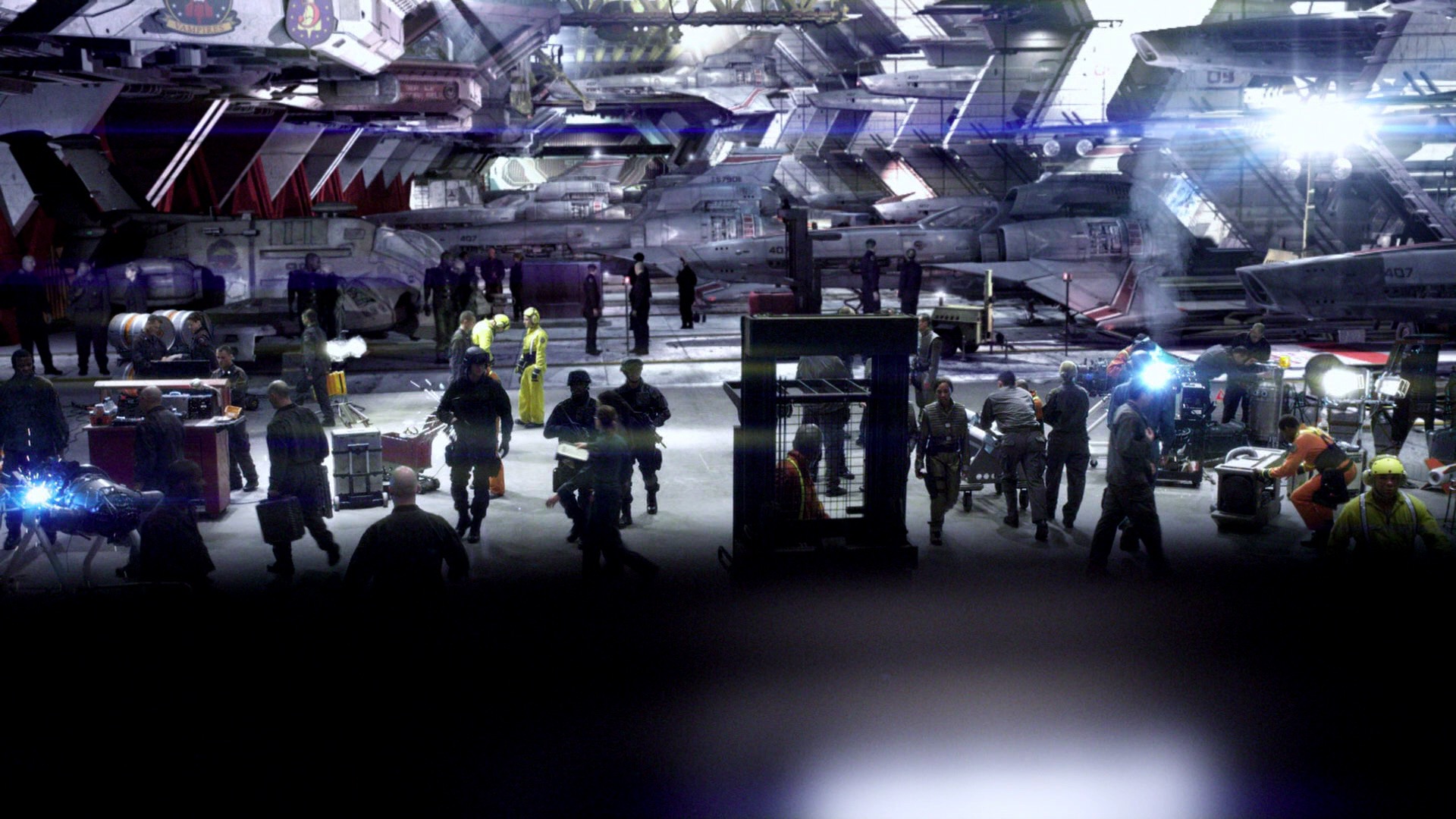
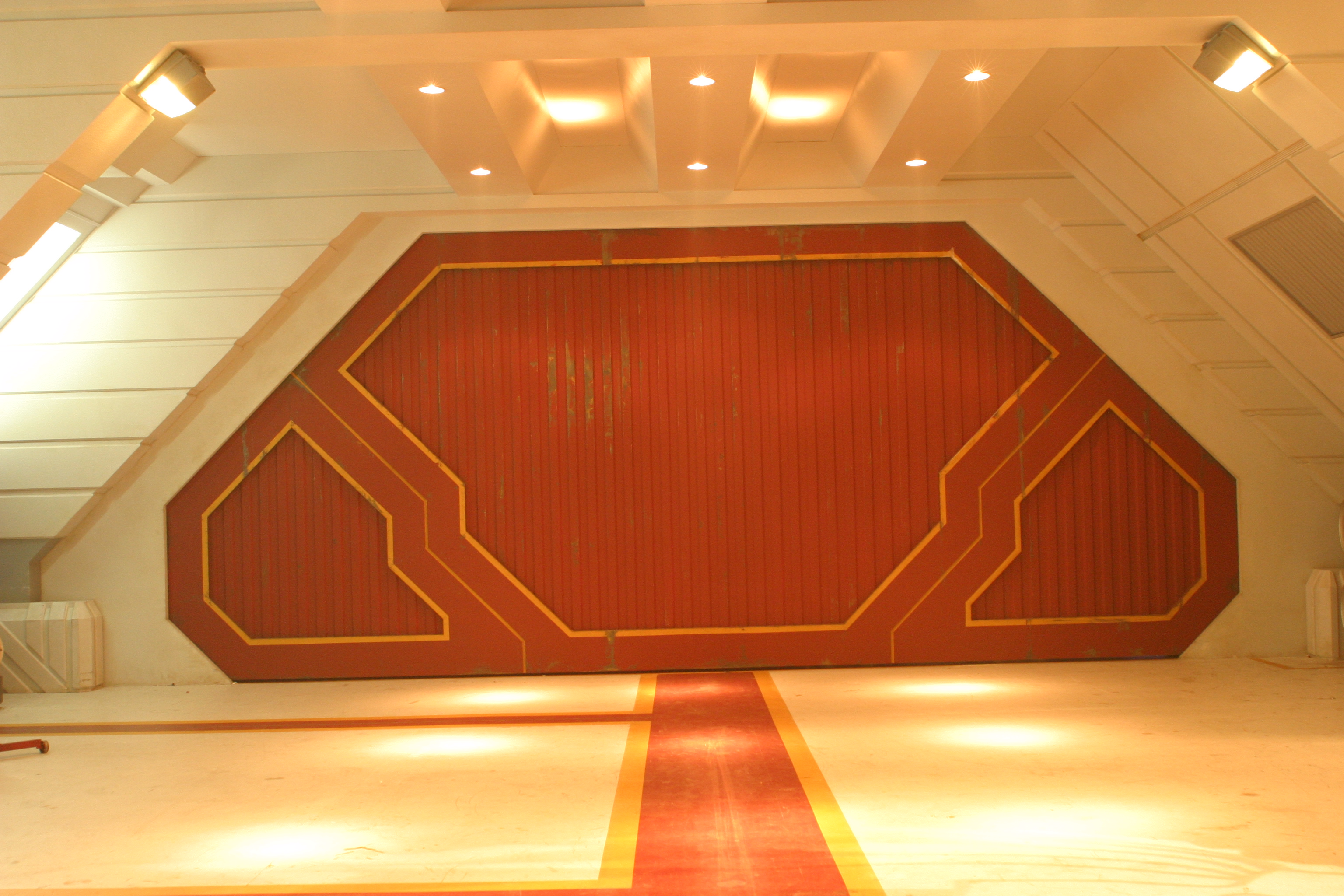
The “shop module” seems to be identical to the Hotstack on the inboard side. Possibly a bit wider. The outboard side has the dividers moved a bit wider to accommodate the large, nuBSG-style door. I’m going to assume that they don’t actually meet, because the inboard side doesn’t look that much wider than the regular stack. This door seems to be the same size as the elevator doors in the parent series, and at the end of an elevator-sized cubby. That’s probably not an elevator, though. The shop module is only visible in this shot of the Wild Weasel. It’s difficult to be sure, because the apparent launch tube entrances are now deep in shadow, and possibly missing entirely, and the camera angles are low enough that most of the background is taken up by the ceiling.
The fact that the door is the same scale as the ones on the original hangar does let me estimate the size of the new, much larger doors: About 175% or the originals. This isn’t quite the clean doubling I was hoping for.1I started drafting this post and making the diagrams long before I finished and posted it, and I cannot for the life of me remember how I deduced the size of the large doors from the regular-sized ones. Possibly from the height?
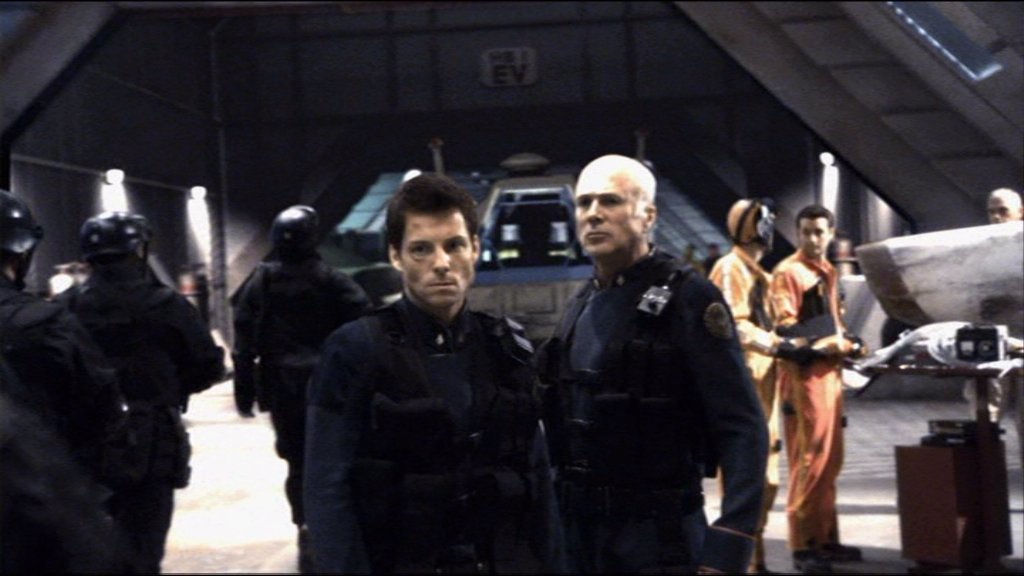
There’s another briefly-seen segment which may be part of the shop module, where Adama first climbs into his Viper at the end. Notably, it seems to show a second hangar deck running parallel to the main one. There are definitely two series-sized elevator-style doors next to each other.

Distant shots of the elevators show two Vipers sitting comfortably (diagonally!) on one.

Modules fit next to each other, divider to divider, in their units of three. They do not join continuously.
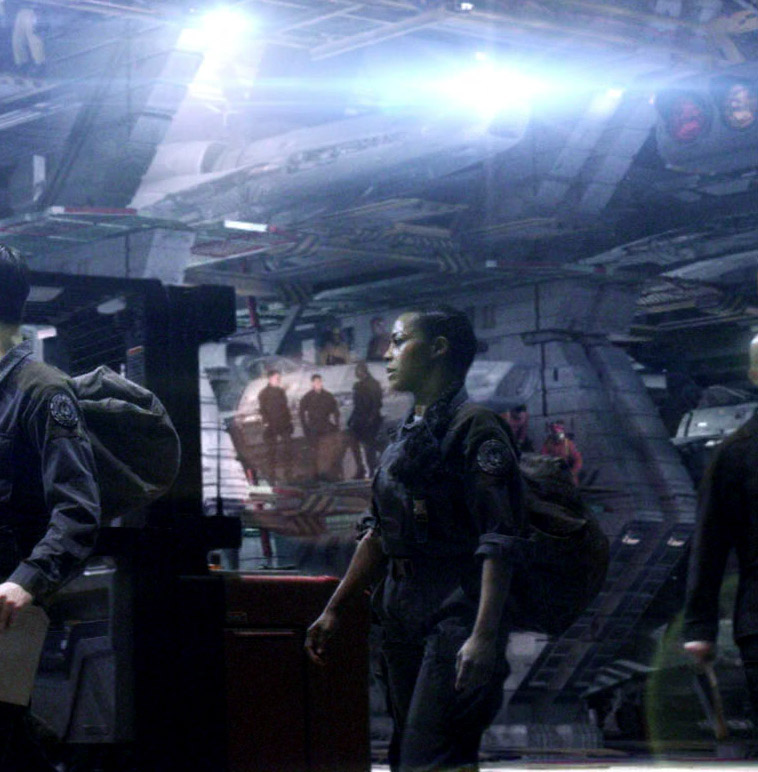
There is a small personnel elevator Adama takes at the beginning and end of the film. It doesn’t appear in wide shots, but it seems to be somewhere in the area of the aircraft elevators. There are monitors mounted in the shaft, where they are all but unreadable as people pass by going up and down. To be fair, I’ve also made strange ergonomic choices for virtual sets.
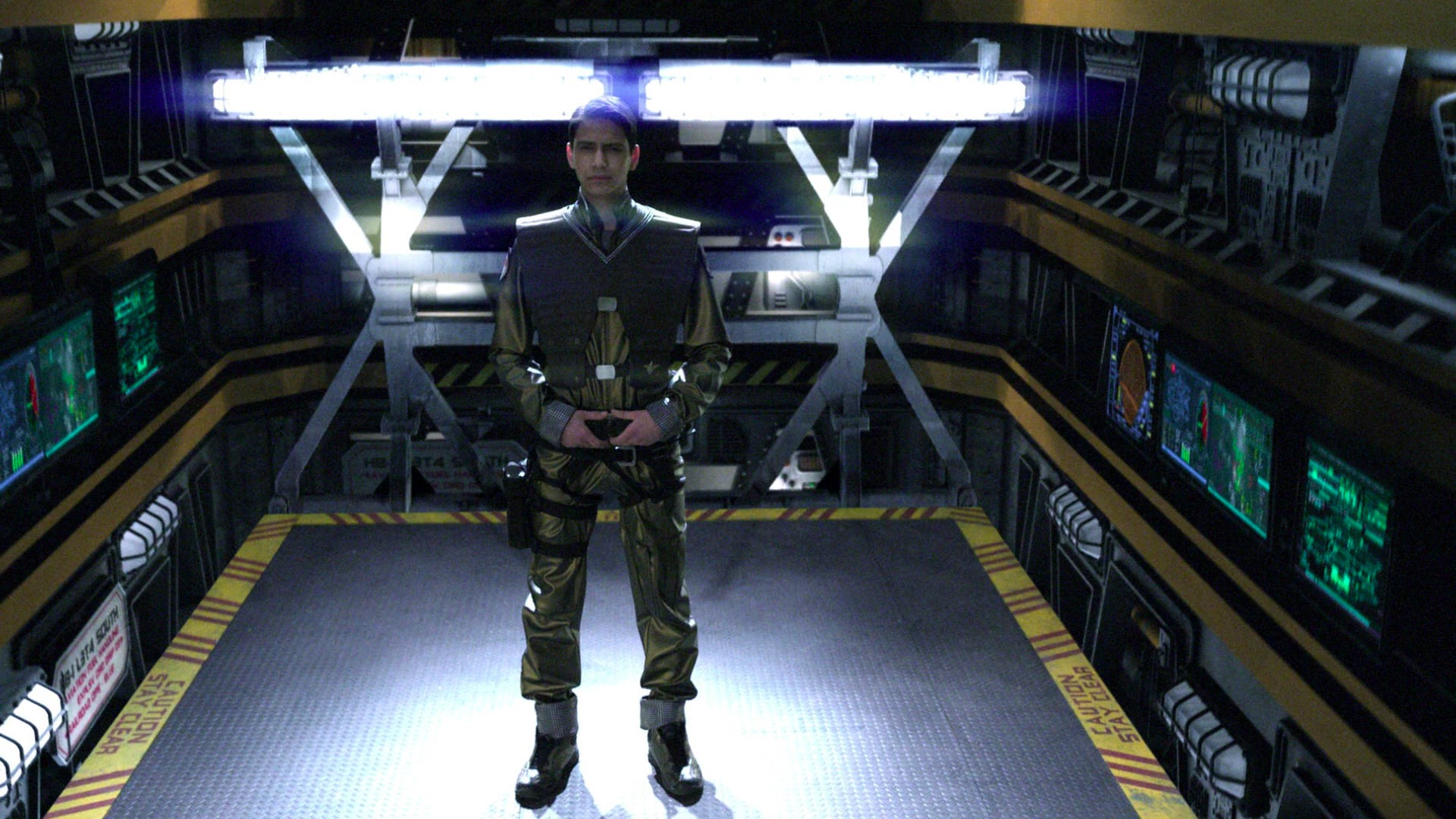
The closing sequence has Adama in his first Viper being lowered into a launch tube. He starts in a redress of the bottom level of the Viper stack and then lowers past another level to the Viper tube. The Viper itself prevents us from seeing if there’s a same-deck Viper door or if they only way into the tube is from above.
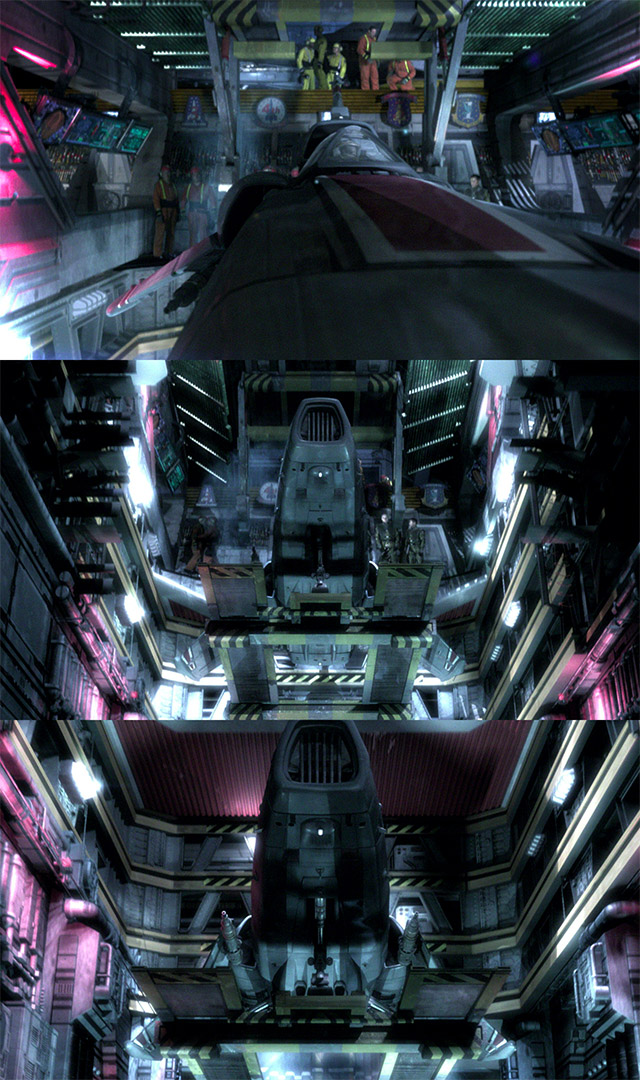
There are a few ways to deal with this.
There’s the zig-zag approach, where Vipers come down the Hotstack, are wheeled across the hangar into the launch bay, where they go down another elevator into the tube, which is most consistent with everything we see on-screen.
There’s the high deck approach, where the Viper did, in fact, start at the bottom level of the Hotstack, and dropped through a previously unseen trap-door into the tube. That would mean the apparent launch tube entrances on the hangar deck weren’t that, but if it weren’t for that niggling detail, I’d say this was probably the intent, given the elevator starts at a level that appears to be the bottom of the Hotstack.
And there’s the overhand approach, which is a more compact version of the zig-zag, where the Vipers go over roof the hangar bay, This has the advantage of preserving the deck-level tube entrances, but is almost totally unsupported by what’s on-screen, adds yet another level to a ceiling height that’s only barely workable and has two independent single-Viper elevator systems that are even more of a pain to get between than the zig-zag.
I was going to diagram all of these out, but it seemed like a lot of work to drive home the one fatal flaw with the launch-tube elevator: There’s a fixed amount of space to play with. The hangar’s ceiling has to be below the hangar deck, and its floor has to be level with (or above) the launch tubes, and that vertical space is not eight Vipers high. It’s barely three Vipers high.
There are also some new wayfinding signs, but they all say “Hangar 04- South,” no matter what. I would assume that “South” is “Aft” and “North” is “Forward.”
Synthesis:
Okay, let’s take what we’ve got and see if we can run with it.
First of all, let’s compare the digital set blueprint with the original, scaled to each other.
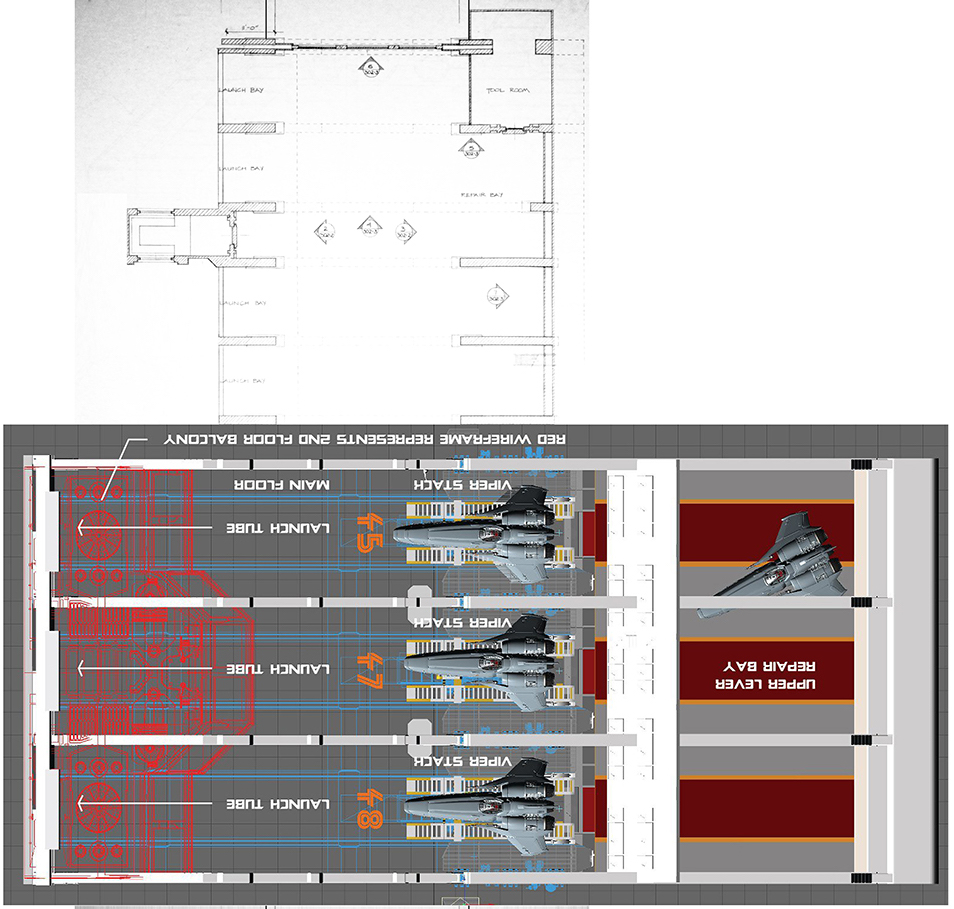
As you can see, aside from being wider along the width of the hangar, each individual launch tube is also wider along the length. This makes it easy to accommodate Raptors and the apparently-enormous Viper Mark III, but to fit the exterior arrangement of the launch tubes, it’ll have to go. The Upper Level Repair bay, which is barely visible in the show, is also going to be omitted, since it’ll push the hangar deck far enough outward that the elevators would come out on the runway (or the hangar will be sticking well out of the inner side of the flight pod). There are also no gaps accounting for the control rooms between launch tubes in the later version (which correspond to armor ribs on the exterior). Here’s a version of the standard eight-tube segment from the series Photoshopped into a reasonable approximation of the Hotstack, taking the exterior arrangement of the tubes into account.
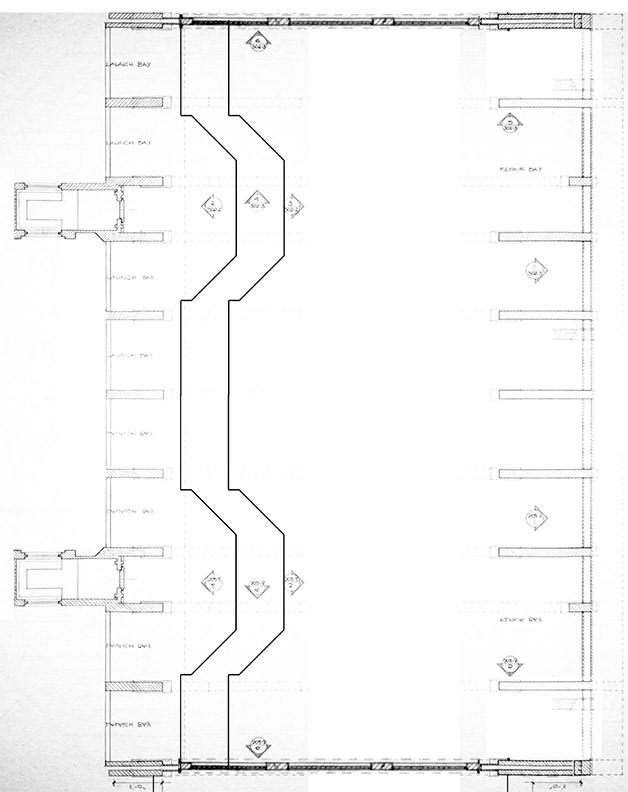
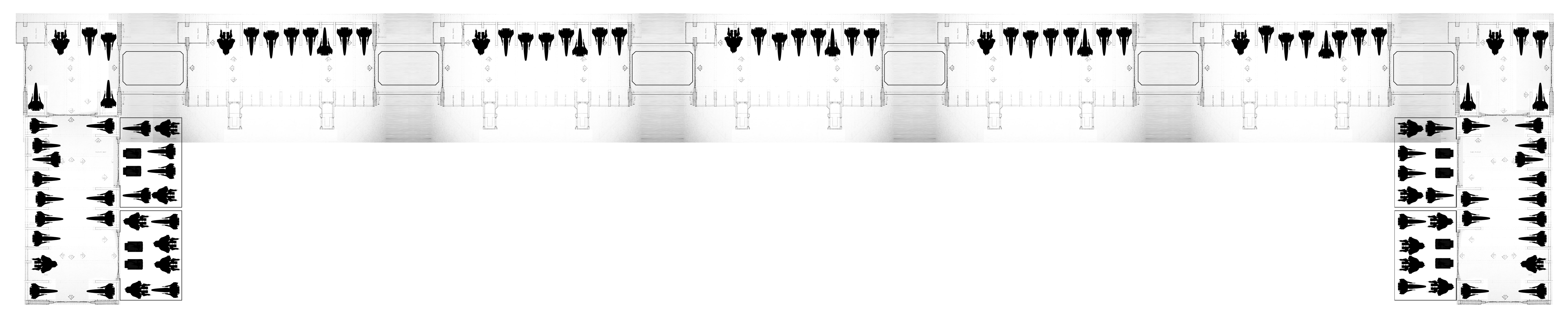
If we want to keep the endless vistas, we’ll need to eliminate the middle two elevators. There’s no other way to to take sections of hangar that are 8 Viper-slots wide and make them fit 21+ Hotstacks. That won’t be a problem, because we’ll double-size the inner two remaining elevators to account for the large elevator we see, so gross elevator-capacity remains the same. We can get away with that because we don’t see the inner midsection of the upper deck on-screen, so it could be totally different than the series-era configuration. The space left by the missing elevators also allows us to drop in two shop modules.
“But the same elevator capacity isn’t good enough!” I assume someone complains for rhetorical reasons. “There are a ton more Vipers to worry about, now. We need even more elevators” While it wasn’t on-screen, that’s taken care of by the Hotstack. Doug Drexler implies that the Hotstack extends all the way up to the landing deck, to clear an apparent bottleneck in the landing process:
The Eddie Olmos BSG established a modest number of (three or four) elevators that brought vipers from the landing deck above. The turn over capability was insufficient. Even if you only landed 50 vipers, it would take forever to get them downstairs, inspected, repaired, refueled, re-munitioned, and back on line. Our solution was that back in the good old days, each viper bay had four levels, inspection, minor repairs, avionics, munitions and fueling. Each bay had it’s own independent conveyor system.2Source
So let’s say that along the inner side of the landing deck are small bays, not unlike the launch tube airlocks on the hangar deck, where a Viper can be wheeled in and lowered into the hangar system, without using one of the large elevators. This also accounts for the barely-seen fifth level that Vipers lower down from.
We can also say that the hotstacks under the arms of the flight pod connect to a longer elevator system that allows Vipers to be transferred from one pod to another. Presumably, when the rest of the hotstack system was dismantled post-war, these elevators remained, perhaps behind retractable panels, accounting for the scene in the Miniseries where all the museum Vipers were moved from the starboard flight pod to the port pod, even though the starboard launch and landing decks had been sealed. I always wondered how they pulled that off.
I’m going to just ignore the elevator to the launch tube at the end of the film. While that concept will come in handy for the Pegasus and Valkyrie, in this case, it just changes this from “difficult” to “impossible.” The height just isn’t there.
Height is the biggest limiting factor, here. The space between the level of the launch tubes and the landing deck is about three Vipers high. There’s no way to accommodate a five-level stack, or a three-level launch tube elevator, never mind both. Since we barely see it and it’s mostly implicit, I cut out the fifth level of the stack, and have the fourth level open onto the deck. I brought the ceiling back down a bit. And we’ll just have the Vipers go from the stack to the launch tube the old fashioned way.
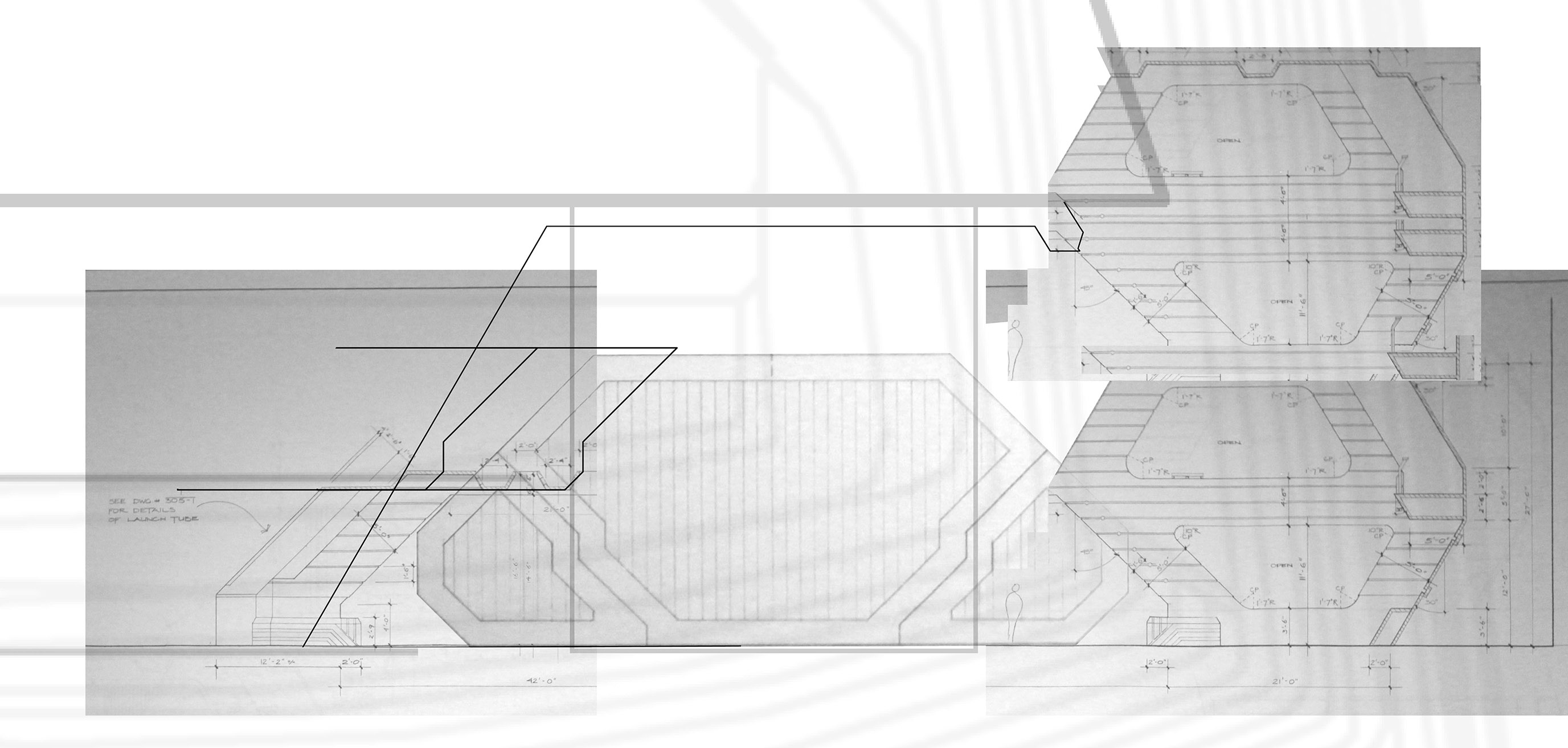
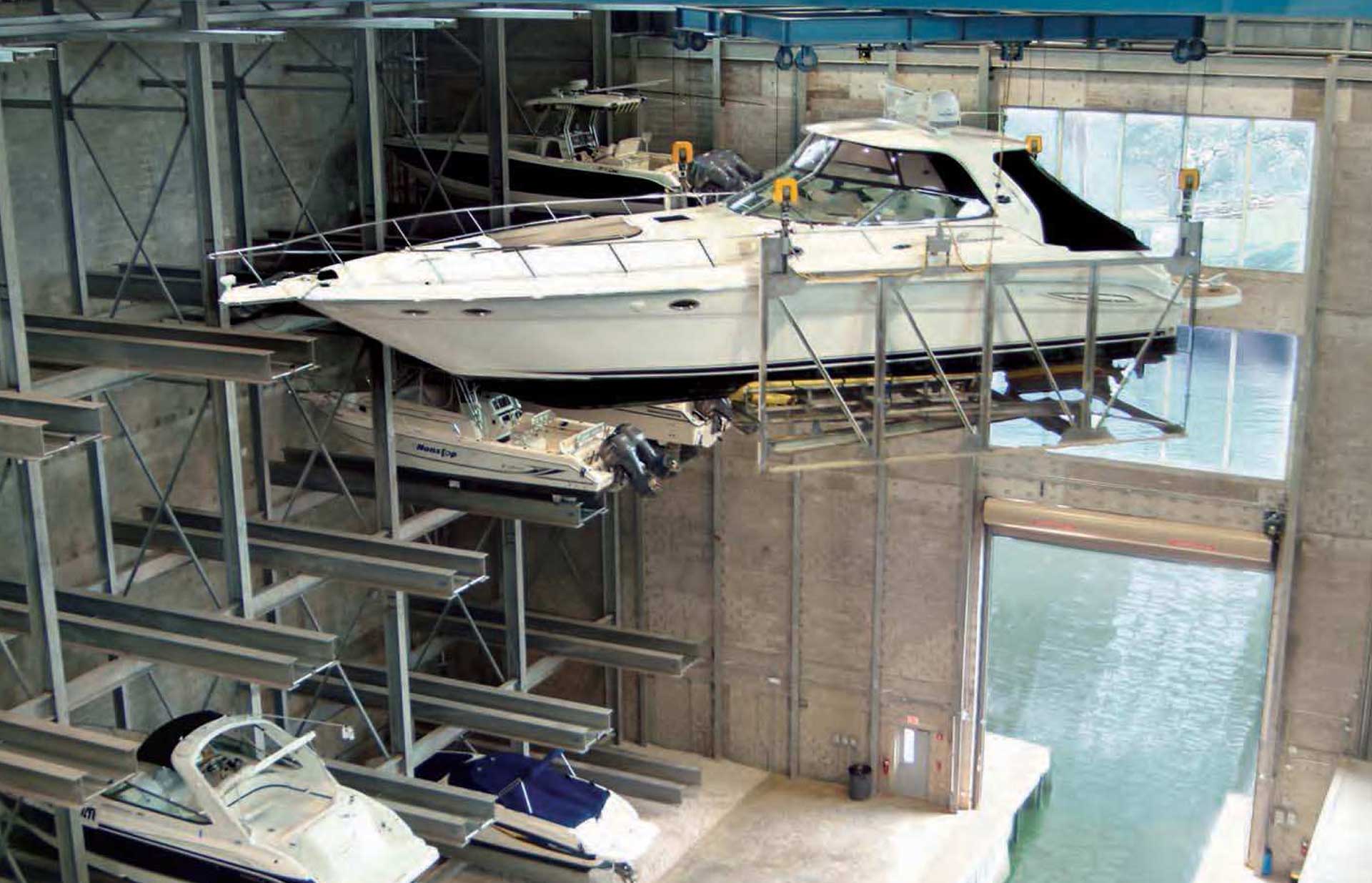
But I digress. We’ve taken care of the center section, but that still leaves two more eight-tube segments, plus the additional storage endcaps I wished into existence last time. I’m also going to get rid of the wider “repair bay” slots that took up the space behind the launch control rooms, since there are no similar gaps in the Hotstacks as seen. The tiny stacks could have stairs or personnel elevators. The tool rooms are also eliminated, since the wall behind the Hotstacks all have tools and worktables set up. I haven’t decided if the eight-tube segments should also have deck-access hotstacks. They could, we wouldn’t have seen them if they were there. As for the storage sections, I imagine they also use stacks to increase storage area. In this case, they’d be less of a magazine and more of a rack. Well, racks are cool. Dry storage boat racks3Source still blow my mind when I see them. The only way I expect to see a boat three floors up is if there was a hurricane.
I’ve also rearranged the storage sections at the end of the hangars to better resemble the area Adama passes through at the end of B&C. I imagine the second elevator-sized door which suggested a parallel hangar deck opens to a pass-through, so ships can be moved from the storage section to the launch area even when the elevators are in use.
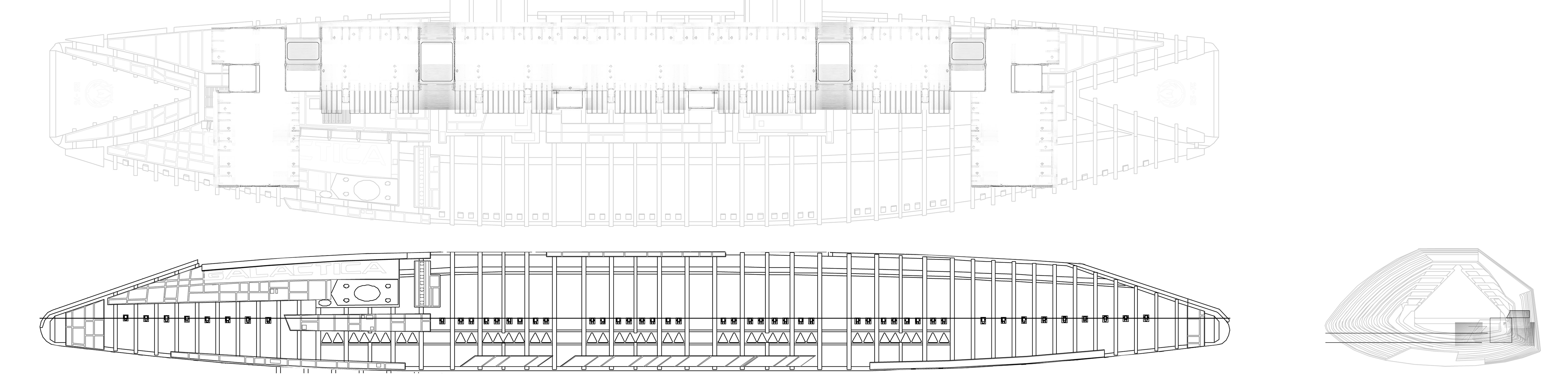
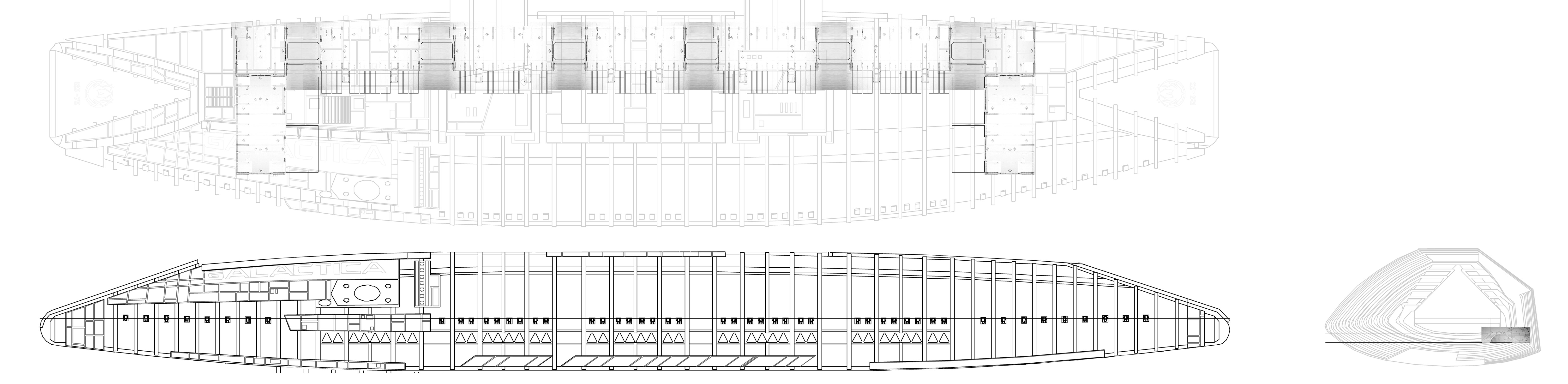
Here’s a cross-section of how I envision the hangar bay. It just barely fits in the flight pod (or just barely doesn’t, but it’s a TV vehicle. “Close” is good enough. I’m just glad I didn’t have to rotate anything 36 degrees counterclockwise to get it to fit). Here it is, along with my interpretation of the series version for comparison.
Conclusions and speculation:
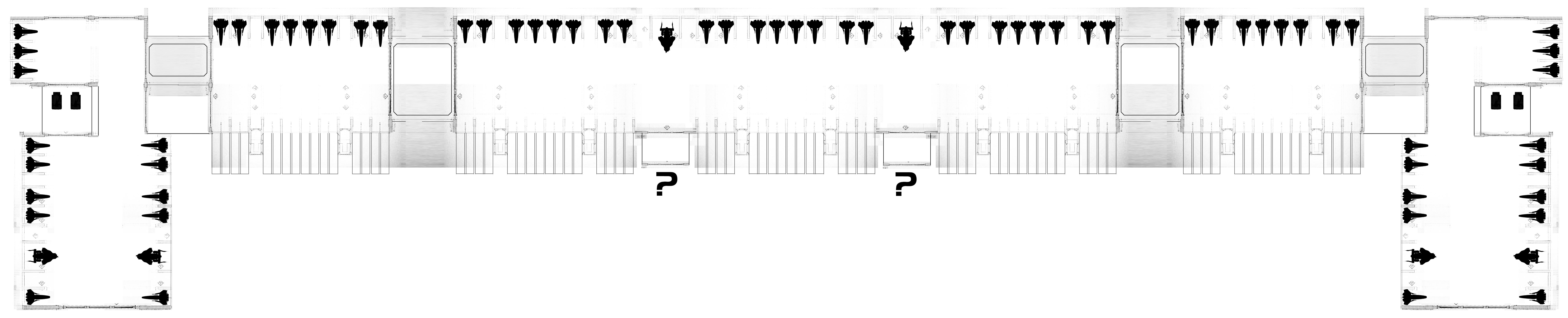
The Hotstack increases the capacity of Galactica considerably, though perhaps not by as much as you’d expect. There are deck-level berths for 66 Vipers4I shrank the Mark IIIs in this illustration so they’re the same width as the launch tube, which actually makes them slightly shorter than the Mark II in my layout, and 6 Raptors. Assuming they’re all stacked three high, that’s nearly 200 Vipers and 20 Raptors per pod, or 400 Vipers and 40 Raptors as a low-end total estimate (compared to an estimate of 160 Vipers and 40 Raptors for the series version, which was the high-end estimate). And that’s a conservative estimate. Blood and Chrome seemed to indicate the war-era Colonials had no problems with storing ships outside of their berths, on the hangar deck or even exposed to space on the landing deck, even when they aren’t on the run and undercrewed. If you filled in all that floor space with extra Vipers, you could increase capacity even more, never mind the possibility of top-deck parking. I also have no idea what should go behind the door to the shop modules (indicated by the “?” I put there), so there could be even more ships crammed in back there.
There are aspects of this that make sense (the battlestars, like a lot of science fiction spacecraft, seem to have a lot more room than they need for the amount of crew they had, so tripling the flight crew still wouldn’t make it cramped). The series-era Cylon Basestars had, depending on the model, either 864 or 434 launch slots for Raiders, implying they could carry well over a thousand fighters if they had any internal fighter storage. If the war-era Baseships had a similar number of raiders, the Colonials may have needed to pack a greater number of fighters into their battlestars.
On the other hand, there isn’t a lot of runway space for all those Vipers to land on. The combat landings we saw in nuBSG were very chaotic, and it was a shock that more Vipers didn’t smash into each other skidding to a stop than were shot down.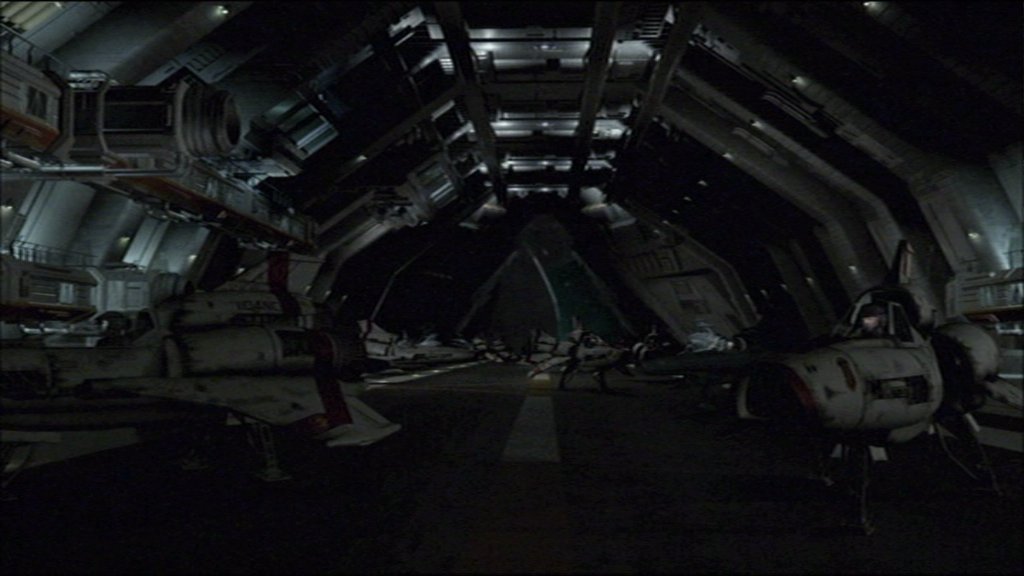
I’m not sure the ship has the physical deck space to accommodate over two hundred fighters landing at once. The tactics implied by a Hotstack-equipped Battlestar seems to be a far lengthier encounter than anything seen in the parent show (or, for that matter, in B&C). The B&C model makes more sense if it’s built for long battles, where Vipers are constantly landing during an engagement, to be replenished and relaunched because the fight has actually gone on long enough for them to run down on fuel, weapons, or air.
Also, the arrangement of launch tubes and elevators is far more straightforward with the nuBSG approach. Despite the in-universe rationale, it still looks a lot more like B&C was an expansion of the original design, rather than the series version of the ship being stripped-down.
Still, it is what it is, so I’ll try to speculate on why. The Cylon War came as a surprise to the Colonials, and the Battlestars were built quickly, specifically to combat the Cylons. Presumably, it took time for the Cylons to design and construct their own forces, so the first Basestars may have appeared while Galactica and the other Battlestars were still being built, necessitating on-the-fly redesigns of the ships to counter the emerging Cylon tactics (in addition to whatever revisions they were making on their own, being a heavily-computerized society designing their first hand-operated spaceships). I’d propose the Galactica was designed with a hangar system more like what we saw in the series, perhaps with two levels of Viper storage instead of the full hotstack, and the new requirement for a larger fighter wing led to it being widened and expanded while under construction. After the war, when they no longer need so much cannon fodder and could go for quality over quantity, the hangars were rebuilt to a stripped-down version of the original design, which fit in better with the structure of the ship, anyway.
There is some other precedent about the ship being redesigned during construction: the engineering section is very similar to the TOS Galactica design, with four extra nacelles bolted on. Perhaps the TOS version was going to be the next big thing in Colonial spacecraft, but was revamped during design and construction until it came out as the B&C version.
While the hotstack design is great for a lengthy battle or siege, if a Battlestar had to escape in a hurry, if would never be able to recover all of its Vipers within a couple of minutes. Now, you could argue that, during the series, Galactica and Pegasus were in a unique situation, and the Colonial military wouldn’t have intended for their ships to end every single encounter with the enemy by retreating from an overwhelming force. However, the fact that the latter-day Battlestars were even capable of doing so suggests the during the Cylon War, something happened that made planning for hit-and-run attacks and quick withdrawals worth incorporating into Colonial ship designs (consider that Pegasus has only 40 launch tubes per pod, same as Galactica, but has more than double the landing deck area, implying quickly landing a lot of fighters was a more important goal than quickly launching them). My guess would be that there was a disastrous defeat for the Colonial forces, where a Battlestar had to jump away, leaving its fighter force behind. Or, if you wanted to be really cruel, a Battlestar was destroyed, and one of its sister ships tried to take on her fighters but didn’t have the space and had to deliberately leave them behind in a slower-paced rout. The long-term solution would be switching to a quality-over-quantity doctrine for fighters, but short-term, you might expect to see a “recovery ship” designed to join Battlestar Groups that had the opposite trade-off from Galactica; far more landing space than she needed for the number of Vipers she could carry (the Theseus, from the Diaspora: Shattered Armistice fan-game, would fill this role nicely, having about four times the landing deck area as Galactica, but less internal hangar space). Her role in large-scale engagements would be specifically to give fighters someplace to land just for the duration of an emergency FTL jump.
While I’m here, I’ll put down another thought I had. I mentioned near the beginning of the post that there were two version of Galactica seen during B&C. While I have an opinion about which one is correct, I don’t have an issue with the other version being a design that also existed during the war. In both cases, the major differences between the B&C versions and the series Galactica is a full set of armor plating, and many more large gun batteries. My take is that these guns are less reliable and have a slower rate of fire than the series-era version, so that while the B&C Galactica looks imposing, and can deliver one hell of a salvo, in terms of overall rate of fire she at best matches her future equivalent. Perhaps the Columbia, seen in the flashback sequence in Razor, was the first Battlestar to be refit with a smaller number of more effective batteries (perhaps before the batteries were fully capable of picking up the slack, given she was overwhelmed and destroyed by Cylon missile barrages).
Likewise, given that the Galactica-type5Okay, real dark-horse opinion, here: I consider the nuBSG ship to be Jupiter-class, as asserted by one obscure behind-the-scenes book. I like the idea of Colonial Battlestar classes being named for deities. ships that were still in service in the nuBSG era had patchwork armor just like the series-era Galactica, that clearly wasn’t done because of the decommissioning, but was a standard modification. I say the war-era Battlestars were overbuilt, and much of their armor was later determined to be superfluous (perhaps because the hull underneath most areas provided adequate protection, and/or the newer, faster gun batteries created a flak barrier thick enough that hardly any Cylon missiles were expected to score a hit at all), so it was removed, making the ship faster and more maneuverable.
I think one-on-one, Admiral Adama’s old warhorse Galactica could beat Commander Nash’s brand-new Galactica. Adding in the fighter compliment would change things, since the B&C version has such an advantage in numbers, but ship-to-ship, I think the Galactica was improved over her lifespan, rather than becoming less effective. She could still be a “white elephant” in her latter days, but as it turned out Galactica being too much battlestar as opposed to something leaner probably saved humanity.
| ↑1 | I started drafting this post and making the diagrams long before I finished and posted it, and I cannot for the life of me remember how I deduced the size of the large doors from the regular-sized ones. Possibly from the height? |
|---|---|
| ↑2 | Source |
| ↑3 | Source |
| ↑4 | I shrank the Mark IIIs in this illustration so they’re the same width as the launch tube, which actually makes them slightly shorter than the Mark II |
| ↑5 | Okay, real dark-horse opinion, here: I consider the nuBSG ship to be Jupiter-class, as asserted by one obscure behind-the-scenes book. I like the idea of Colonial Battlestar classes being named for deities. |